Where are you guys?
Hope you'll be there tomorrow (Tuesday) at 12 o'clock since Wednesday not everybody can meet.
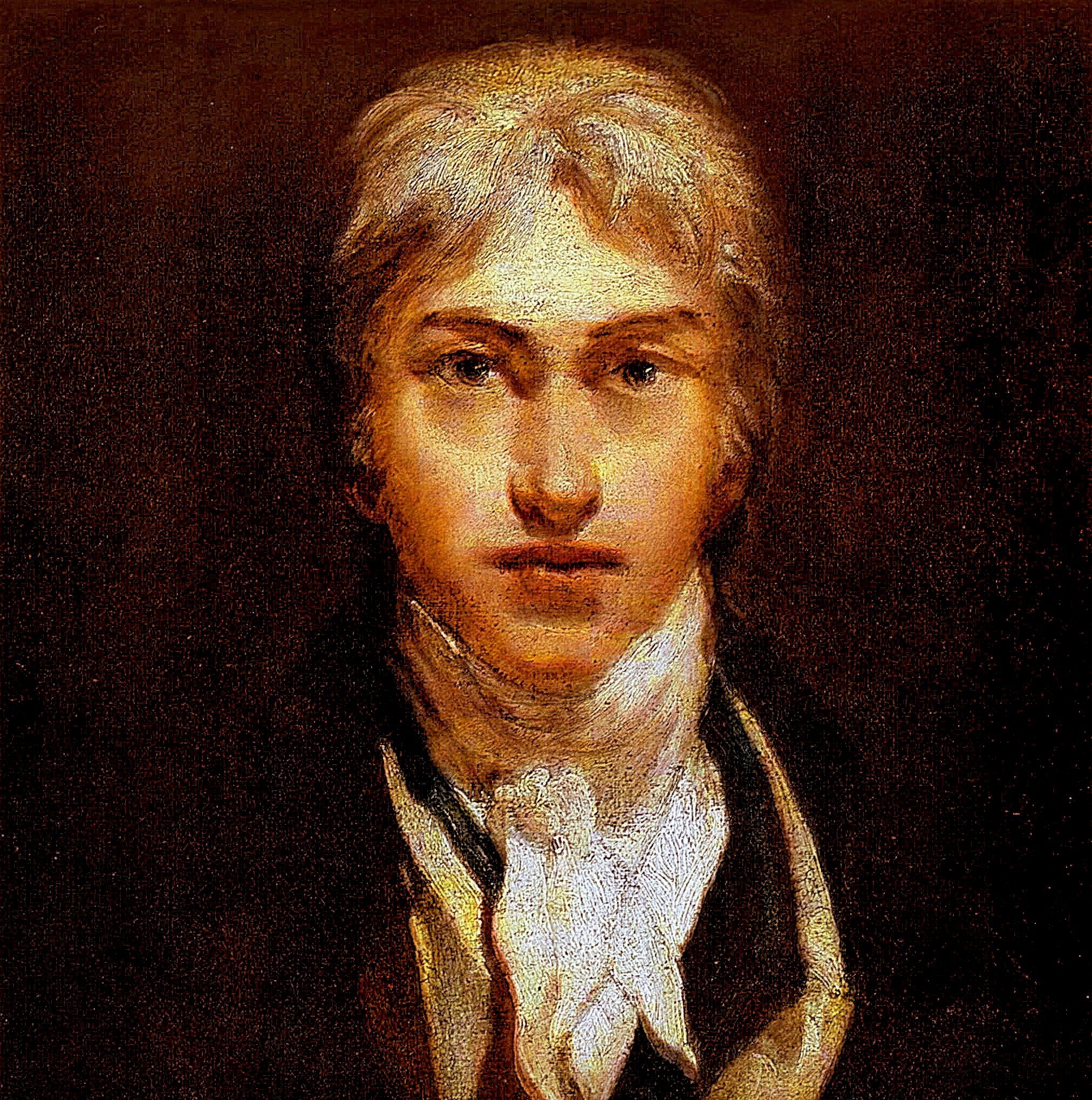 Joseph Mallord William Turner ( J. M. W Turner) was a English Landscape painter, printmaker and a watercolourists. He is considered a prominent part of the Romantic age around Europe. While He lived Turner was a controversial figure, but is now seen as the artist who made landscape painting such a large part of art. One thing that separated Turner was that he was successful throughout his career.
Commissioned and acquired several of these, which he rightly considered to be the greatest watercolours by Turner, and therefore the most wonderful of all English watercolours (2000: 9 Herrmann)
When Turner died he left behind a large legacy that cemented his place in the Romantic age and how it has influenced art today. When Turner passed away at the age of 76, he left a small fortune behind to support artists like him. He also gave money to The Royal Academy of Arts, which today's gives out 'The Turner Medal' to its deserving students.
In 1974, an American named Douglass Montrose-Gream opened a museum in the USA to house all pieces of art that he had gathered over the years.
In 1984, a very prestigious annual art award called 'The Turner Prize' was named after him and 20 years after that it was renamed to 'Winsor & Newton Turner Watercolour Award.
In 2005, the BBC held a public poll to find 'Britain's greatest painting' and 'The Fighting Temeraire' by Turner was voted into the number one slot.
At this current time, there is a museum being built in Margate to celebrate Turners connection to the town.
His reputation as one of the most important British painters ever is both deserved and justifiable. Landscape and maritime art have gained respect due almost single handedly to his work. He remains a towering figure in British art even 150+ years after his death and a visionary who bridged the gap between "traditional" art and Modernism.Turner was considered as 'the painter of light' due to the way he encapsulated the sunlight and how it affected his image. This technique is still used today by artists and it was pioneered by Turner. If not invented, then at least made popular.
Perhaps Turners most important influence on today's society is just how popular he is. With 300 Oil Paintings and 20,000 works on paper under his belt, to still be seen as a success and a genius in this stage of his life is incredible. Turners paintings were deemed as romantic in the time and even now they are seen as masterpieces.
Works of Turner:


Bibliography:
Alfred Lys Baldry (1923) William Turner of Oxford: water-colour painter, born 1789, died 1862 ; Liverpool ; Walker’s Galleries
Jan Morris (2001) Oxford: Oxford paperbacks ; Oxford ; Oxford University Press
Luke Herrmann/Colin Harrison/Joseph Mallord/ William Turner (2000) J.M.W Turner Issue 15 of Ashmolean handbooks ; Oxford ; Ashmolean Museum
Sam Smiles (2007) J.M.W Turner: The making of a modern artist ; Manchester ; Manchester University Press
William S. Rodner (1997) J.M.W Turner: Romantic painter of the industrial revolution ; California ; University of California Press
Anthony Bailey (1997) Standing in the sun: a life of J MW Turner ; London ; HarperCollins

Ludwig Van Beethoven was born in 1770 in Bonn. he was a German composer and pianist, and one of the most influential artists of the transition from the Classical Period to the Romantic Period.
Beethoven Symphonies are the highest manifestation of his art and it sets the beginning of his work into the Romantic Era, he created this innovative sense of music by incorporating choral effects into his hitherto of only instrumental music, in the case of the 9 Symphony as well as his introduction of harmonic crescendos, although influenced by the French composers of the Revolution, Beethoven added the sense of meaning into it, where a similar melody would produce intense feelings rather than only presenting an image. And this is what mostly distinguishes Beethoven's music.
Beethoven's music is known by the great diversity as well as the spiritual power, that makes it extremely effective, producing feelings to any audience. His music was not only dealing with self- expression, but it was also of moral and ethical power, "fighting" against the problems of human freedom, justice, progress, and community.
Beethoven was considered a Romantic artist because his major themes of life were based on beauty, drama, melancholy, depression and individualism. He mainly believed in the expression of his own feelings and applied it to his own music.
His music not only influenced generations that came after him, but also is still famous nowadays. On one hand, Musicians use music as a vehicle to express their inner feelings and to spread their own views to the world, morally or politically, applying meaningful lyrics to a song. One the other hand, Music composers working for a soundtrack of a certain film, share the same ideals of Beethoven and of the Romantic artists, searching of the perfect notes to provoke certain feelings accordingly to the feature.
Beethoven's most magnificent work, 9. Symphony
How beautifully produced is this piece of work, really starting emotions inside anybody who listens it and making it one of the most notorious of all time, used as inspiration by many.
This inspiration is visible in some contemporary soundtracks, Such in Star Trek Opening Theme
Also, to highlight the importance of music conveying political and moral views, which started at that time and has been transported to the present time. Although Beethoven didnt use lyrics to present his views he relied on the power of the chords to do so. Artists nowadays are "facilitated" by adding their own thoughts and views into a song conveying something based on feelings, moral or political issues.
I think a good example is U2's Sunday Bloody Sunday, where music is being used as a reaction against the terrifying attacks in Ireland 1972.
Beethoven Symphonies are the highest manifestation of his art and it sets the beginning of his work into the Romantic Era, he created this innovative sense of music by incorporating choral effects into his hitherto of only instrumental music, in the case of the 9 Symphony as well as his introduction of harmonic crescendos, although influenced by the French composers of the Revolution, Beethoven added the sense of meaning into it, where a similar melody would produce intense feelings rather than only presenting an image. And this is what mostly distinguishes Beethoven's music.
Beethoven's music is known by the great diversity as well as the spiritual power, that makes it extremely effective, producing feelings to any audience. His music was not only dealing with self- expression, but it was also of moral and ethical power, "fighting" against the problems of human freedom, justice, progress, and community.
Beethoven was considered a Romantic artist because his major themes of life were based on beauty, drama, melancholy, depression and individualism. He mainly believed in the expression of his own feelings and applied it to his own music.
His music not only influenced generations that came after him, but also is still famous nowadays. On one hand, Musicians use music as a vehicle to express their inner feelings and to spread their own views to the world, morally or politically, applying meaningful lyrics to a song. One the other hand, Music composers working for a soundtrack of a certain film, share the same ideals of Beethoven and of the Romantic artists, searching of the perfect notes to provoke certain feelings accordingly to the feature.
Beethoven's most magnificent work, 9. Symphony
How beautifully produced is this piece of work, really starting emotions inside anybody who listens it and making it one of the most notorious of all time, used as inspiration by many.
This inspiration is visible in some contemporary soundtracks, Such in Star Trek Opening Theme
Also, to highlight the importance of music conveying political and moral views, which started at that time and has been transported to the present time. Although Beethoven didnt use lyrics to present his views he relied on the power of the chords to do so. Artists nowadays are "facilitated" by adding their own thoughts and views into a song conveying something based on feelings, moral or political issues.
I think a good example is U2's Sunday Bloody Sunday, where music is being used as a reaction against the terrifying attacks in Ireland 1972.
The Enlightenment - intellectual movement
They believed that human reason could be used to combat ignorance, superstition, and tyranny and to build a better world. Their principal targets were religion (embodied in France in the Catholic Church) and the domination of society by a hereditary aristocracy.
Michel de Montaigne
If we cannot be certain that our values are God-given, then we have no right to impose them by force on others.
This shift toward cultural relativism ... is one of the hallmarks of the Enlightenment....
Enlightenment thinkers used the examples of other cultures to gain the freedom to reshape not only their philosophies, but their societies.
The ability of individual effort to transform the world became a European dogma, lasting to this day
they thought that educated and sophisticated persons could be brought to see through the exercise of their reason that the world could and should be greatly improved.
The Enlightenment had weakened the hold of Christianity over society to the extent
The 17th Century
To be sure, logic alone (empiricism..?..) could be used to defend all sorts of absurd notions; and Enlightenment thinkers insisted on combining it with something they called "reason" which consisted of common sense, observation (Critique of pure reason), and their own unacknowledged prejudices in favor of skepticism and freedom.
The Political and Economic Background ( what were the conditions for enlightenment to appear ( but it‘s not a cult .soc. backrounf in which romanticism came out)
During the late Middle Ages, peasants had begun to move from rural estates to the towns in search of increased freedom and prosperity. As trade and communication improved during the Renaissance, the ordinary town-dweller began to realize that things need not always go on as they had for centuries. New charters governments laws businesses could be begun.
SO the pressure for change continued to mount.
These merchants had their own ideas about the sort of world they wanted to inhabit, and they became major agents of change, in the arts, in government, and in the economy.
Whereas individualism had been chiefly emphasized in the Renaissance by artists, s, it now became a core value..
chief obstacles were absolutist kings and dogmatic churches....
individualism, freedom and change replaced community, authority, and tradition as core European values.
This is the background of the 18th-century Enlightenment. Europeans were changing, but Europe's institutions were not keeping pace with that change
Most important, the middle classes--the bourgeoisie--were painfully aware that they were paying taxes to support a fabulously expensive aristocracy which contributed nothing of value to society
.
Rousseau vs. Voltaire
Voltaire insisted on the supremacy of the intellect, Rousseau emphasized the emotions, becoming a contributor to both the Enlightenment and its successor, romanticism
The Struggle in Europe
Voltaire and his allies in France, struggling to assert the values of freedom and tolerance in a culture where the twin fortresses of monarchy and Church opposed almost everything they stood for.
Voltaire was joined by a band of rebellious thinkers known as the philosophes: Charles de Montesquieu, Pierre Bayle, Jean d'Alembert
The Heritage of the Enlightenment
the perfect society could be built on common sense and tolerance, a fantasy which collapsed amid the Terror of the French Revolution and the triumphal sweep of Romanticism.
The notions of human rights it developed
Romanticism
Romanticism was more widespread both in its origins and influence
Beginning in Germany and England in the 1770s, by the 1820s it had swept through Europe....
Beginning in the last decades of the 18th century, it transformed poetry, the novel, drama, painting, sculpture, all forms of concert music (especially opera), and ballet
This last shift was the result of the triumph of the class which invented, fostered, and adopted as its own the romantic movement: the bourgeoisie..
the most popular orchestral music in the world is that of the romantic era.... When John Williams created the sound of the future in Star Wars, it was the sound of 19th-century Romanticism--still the most popular style for epic film soundtracks
Folklore and Popular Art
the belief that products of the uncultivated popular imagination could equal or even surpass those of the educated court poets and composers who had previously monopolized the attentions of scholars and connoisseurs. –
Whereas during much of the 17th and 18th centuries learned allusions, complexity and grandiosity were prized, the new romantic taste favored simplicity and naturalness;... . Rather than paying attention to the individual authors of popular works, these scholars celebrated the anonymous masses who invented and transmuted these works as if from their very souls.
Nationalism
The natural consequence of dwelling on creative folk genius was a good deal of nationalism... Goethe deliberately places German folkloric themes and images on a par with Classical ones in Faust.
Shakespeare
But one of the early effects of this interest in the folk arts seems particularly strange to us moderns: the rise and spread of the reputation of William Shakespeare. Although he is regarded today as the epitome of the great writer, his reputation was at first very different
Shakespeare's plays did all... with no attention paid to the academic rules
If the English romantics exalted Shakespeare's works as the greatest of their classics, his effect on the Germans was positively explosive
His disregard for the classical rules which they found so confining inspired them. Writers like Friedrich von Schiller and Goethe created their own dramas inspired by Shakespeare. Faust contains many Shakespearian allusions as well as imitating all of the nonclassical qualities enumerated above.
How Shakespear influenced romantics:
To the Romantics, however, he was the essence of folk poetry, the ultimate vindication of their faith in spontaneous creativity. Much of the drama of the European 19th century is influenced by him, painters illustrated scenes from his plays, and composers based orchestral tone poems and operas on his narratives.
Rejecting the Enlightenment ideal of balance and rationalism, readers eagerly sought out the hysterical, mystical, passionate adventures of terrified heroes and heroines in the clutches of frightening, mysterious forces.
Mary Shelley's Frankenstein, is often cited as a forerunner of modern science fiction.
other influential characteristic of the Gothic romance was its evocation of strong, irrational emotions--particularly horror. Whereas Voltaire and his comrades (from Enlightenment) had abhorred "enthusiasm" and strove to dispel the mists of superstition; the Gothic writers evoked all manner of irrational scenes designed to horrify and amaze.
In this they were inspired by certain currents contemporaneous with the Enlightenment, in particular the writings of Voltaire's arch-rival, Jean-Jacques Rousseau.
Rousseau
explored in his fiction the agonies of frustrated love—
It was the romantics who first celebrated romantic love as the natural birthright of every human being, the most exalted of human sentiments, and the necessary foundation of a successful marriage. Whether or not one agrees that this change of attitude was a wise one, it must be admitted to have been one of the most influential in the history of the world.
this change of attitude was a wise one, it must be admitted to have been one of the most influential in the history of the world.
this conviction which continues to shape much of our thinking about relationships, marriage, and the family found its mature form during the Romantic age.
Exoticism
Another important aspect of Romanticism is the exotic
Romantic age was also a period in which Europeans traveled more than ever to examine at first hand the far-off lands of which they had read.
Many male travelers viewed the women of almost any foreign land one could name as more sexually desirable and available than the women at home, and so they are depicted in fiction, drama, art, and opera.
exoticism in literature was inspired more by Lord Byron
Religion
the transformation of religion far removed from traditional religious art.
during the Romantic era many artists were drawn to religious imagery
Religion was estheticized, and writers felt free to draw on Biblical themes with the same freedom as their predecessors had drawn on classical mythology,
For all that many of its features were reactions against the rationalist Enlightenment, Romanticism also incorporated much from the earlier movement, or coexisted with the changes it had brought about.
Individualism
(the social background)
One of the most important developments of this period is the rise in the importance of individualism. Before the 18th Century, few Europeans concerned themselves with discovering their own individual identities. They were what they had been born: nobles, peasants, or merchants. As mercantalism and capitalism gradually transformed Europe, however, it destablized the old patterns. The new industrialists naturally liked to credit themselves for having built their large fortunes and rejected the right of society to regulate and tax their enterprises. they developed their own tastes in the arts and created new social and artistic movements alien to the old aristocracy.
The changing economy made individualism attractive
It was in the Romantic period--not coincidentally also the period of the industrial revolution--that such concern with individualism became much more widespread.
But the most influential exemplar of individualism for the 19th century was not a creative artist at all, but a military man: Napoleon Bonaparte. The dramatic way in which he rose to the head of France in the chaotic wake of its bloody revolution, led his army to a series of triumphs in Europe to build a brief but influential Empire, and created new styles, tastes, and even laws with disregard for public opinion fascinated the people of the time. saw in him the ultimate corrosive force which celebrated individual striving and freedom at the expense of responsibility and tradition.
We call the reckless character who seeks to remold the world to his own desires with little regard for morality or tradition "Faustian," after Goethe's character, but he might as well be called "Napoleonic."
Ideas of romanticism:
The modern fascination with self-definition and self-invention, the notion that adolescence is naturally a time of rebellion in which one "finds oneself," the idea that the best path to faith is through individual choice, the idea that government exists to serve the individuals who have created it: all of these are products of the romantic celebration of the individual at the expense of society and tradition.
Romanticism was successfu in changing the definition of what it means to be human.
SOURCE:
ttp://www.wsu.edu/~brians/hum_303/romanticism.html
rejection of traditional boundaries and categories was a hallmark of the Romantic mindset.)
The spirit of rebelliousness was expressed in the name of modernity, the thirst for which had originated in the Enlightenment but gathered in intensity during the Romantic era
‘It takes courage to be romantic, because you must take risks’ (Brookner, 1971, p.48).
Brookner, A. (1971) The Genius of the Future,
Victor Hugo – acknowledged leader of the romantics
the 1827 Preface to Cromwell by the writer and critic Victor Hugo, an acknowledged leader of the Romantics, is a manifesto accompanying a drama he had written. It is a call to arms to fellow Romantics to cast aside the old ways and embrace a Romantic credo. The main thrust of the Preface is blatantly anti-classical: Hugo demands that writers should no longer work under the tyranny of classical rules or genres. Arguing that there must be a new spirit of liberty in art, he declares, ‘There are no rules; there are no models! Or rather there are no rules except the general rules of nature’ (Hugo, 1949, p.41). While he acknowledges that writers must proceed in a way compatible with their chosen subject, Hugo also denounces the servile imitation of any source
The book in which he was cited:
Hugo, V. (1949) Préface de Cromwell suivie d’extraits d’autres préfaces dramatiques, Paris, Librairie Larousse (first published 1827).
How enlightenment unlocked romanticism :
In a typical switch from an enlightened to a Romantic perspective, the psychological and social ideas opened up by the Enlightenment’s consideration of such places gave way to the application of those ideas to a process of artistic self-exploration and self-expression.
central to Romanticism was the idea that the artist dealt essentially with the inexplicit, with the suggested rather than with the clearly expressed
The view that the world is essentially an ‘impenetrable veil’ rather than a composite of knowable, classifiable and understandable phenomena represents a key shift from Enlightenment to Romantic thinking
Group Meeting at 12pm, Baseroom the structure of the Presentation as well as finishing the Powerpoint presentation.
Presentation Structure:
Main Body:
1. Context
Enlightment- Political and Social Context, in which this movement was created against.
- (e.g. Issues with Church and Monarchy owning all the power in that time)
-Ideals: Individualism, freedom and change, etc... all the things that this movement was defending.
Connection between Romanticism and Enlightenment ( mentioning Industrial Revolution and the extreme Individualism of Napolean) quick reference.
2. Romanticism
Quotations from different sources explaining the ideas of the Romanticism- and we interpret them , either written or talked.
3. Key Individuals
Goethe- writer mainly.
Beethoven
William Turner
4. Historical examples
Goethe's Faust
Beethoven's Moonlight Sonata
William Turner Painting
5. Comtemporary examples
Comtemporary Novel
Star Trek soundtrack or any other.
Concept Art
NEW TASKS
Ruben- Beethoven Importance and Star Trek Soundtrack
Earl- William Turner Importance and Concept Art- James Clyne
Elliot-Victor Hugo Importance for literature then and now
AJ- Victor Hugo Importance for literature then and now
Jolanta- Summary of the Enlightenment and Romanticism
Presentation Structure:
Main Body:
1. Context
Enlightment- Political and Social Context, in which this movement was created against.
- (e.g. Issues with Church and Monarchy owning all the power in that time)
-Ideals: Individualism, freedom and change, etc... all the things that this movement was defending.
Connection between Romanticism and Enlightenment ( mentioning Industrial Revolution and the extreme Individualism of Napolean) quick reference.
2. Romanticism
Quotations from different sources explaining the ideas of the Romanticism- and we interpret them , either written or talked.
3. Key Individuals
Goethe- writer mainly.
Beethoven
William Turner
4. Historical examples
Goethe's Faust
Beethoven's Moonlight Sonata
William Turner Painting
5. Comtemporary examples
Comtemporary Novel
Star Trek soundtrack or any other.
Concept Art
NEW TASKS
Ruben- Beethoven Importance and Star Trek Soundtrack
Earl- William Turner Importance and Concept Art- James Clyne
Elliot-Victor Hugo Importance for literature then and now
AJ- Victor Hugo Importance for literature then and now
Jolanta- Summary of the Enlightenment and Romanticism
Just think your research wasn't in vain and we will use information from it to the presentation.
William Blake was involved in all prominent arts during the 17th to the 18th century. He was involved with painting, printmaking and being a poet. During his life he was largely unnoticed but today Blake is seen as an important role in the romantic age. Growing up during the turn to the industrial revolution, Blake hated how London was changing and becoming a place of work as opposed to a place of freewill and creativity.
During this movement he played a large role in both art and poetry. William Blake’s role in the Romantic era has even led some people to claim him as one of the best artists.
‘William Blake is far and away the greatest artist Britain has ever produced. I feel both elated and embarrassed to say that, because in recent years the critical reputation of the poet, printmaker and radical prophet of the French revolutionary era has been slipping, to say the least. Blake's 'Songs of Innocence and Experience' and 'The Marriage of Heaven and Hell' are never likely to be shifted from their place near the heart of English literature. But Blake thought of himself as a visual artist; he illuminated his self-published writings, illustrated Dante and Chaucer, and painted singular oils such as The Ghost of a Flea.’ (2005:1 Jones)
Jones stats that Blake not only produced literature that is one of the fundamental pieces of English history, but he also excelled at visual arts and saw himself as one much more than he did an author or poet. Blake never ventured outside of more than a day’s walk away from London, but he produced a diverse range of art that embraces ‘the body of God’ or ‘human existence itself’. Blake was fundamental in the development of Romanticism.
Blake was believed to be a spiritual man. Author Jessica Gunderson looked in Romanticism and details how William Blake was influenced in his images.
‘William Blake’s mystical paintings, such as 'The resurrection: The Angels Rolling away the Stone from the Sepulchre', were inspired by his intense spiritual beliefs, including his perceived ability to see visions of God and other heavenly beings.’ (2008:16 Gunderson)

Blake’s belief that he could see and interact with heavenly beings clearly had an influence on his art. ‘The Resurrection’ clearly features heavenly bodies descending down on mortals below. It also shows the mortals worshipping God and loving him.
Could it be that William Blake is so well regarded for the Romantic age because of his array of skills? Blake is acknowledged as a man that not only tried his hands at other fields of expertise, but perfected them.
‘Romanticism, the power to return us to the nineteenth-century dreams not of arts but of Art as the single revelation that single-minded, multitalented creative personalities seek in complementary modes, some with a talent for words, others for music or pictures, all epitomized by an impossibly rare double or triple romantic genius such as William Blake, poet, painter, engraver, and, it was said, a natural musician.’ (1993:237 Curran)
The reason for William Blake’s success regarding the Romantic age is that he was talented in so many areas. With the coming of the Romantic age, it allowed Blake to unshackle himself and explore his imagination in regards to the areas in his life that he feels are most important.
 William Blake is mainly considered as a poet and artist, because these are the fields that Blake was most popular in. But he did venture into other areas that were prominent in the Romantic age making William Blake a big part of the change.
William Blake also had a series of illustrations of Revelation 12 from the Book of Revelation. These include ‘The Great Red Dragon and the Woman Clothed with Sun’
 Blake was obsessed with the image of ‘the creator’, painting the image of God himself in his work called ‘Ancient of Days’. It shows the creation of the world.
 One piece of literature know throughout the world is Dante Alighieri’s ‘The Divine Comedy’. Blake was commissioned to create an ensemble of images to go along with the works. Blake never finished his works making them the last of his career.
‘Palmer was only nineteen and the experience was enormously important to him. ‘Do you work with fear and trembling?’ Blake asked him. When he died, 12 August 1827, Blake was working on a series of designs illustrating Dante.’ (2000; 55 Wu)
‘The Divine Comedy’ is seen as one of the greatest pieces of literature, so to be asked to illustrate the work must have been a grand occasion for Blake. It is sad indeed that he died, unable to complete his work.
 Whilst other artists in the Romantic age explored their own imagination, Blake explored that of others and his own beliefs. All fields that Blake applied himself to he excelled at but most always had a spiritual edge allowing us to see into William Blake’s life and not only see him as an artist or poet, but as a person.
Bibliography:
Why William Blake is the greatest artist Britain has ever produced, Jonathan Jones,
http://www.guardian.co.uk/culture/2005/apr/25/williamblake (Accessed on 25 April 2005)
Jessica Gunderson (2008) Romanticism: Movements in Art; Mankato; The Creative Company
Stuart Curran (1993) The Cambridge companion to British Romanticism; Cambridge; Cambridge University Press
Duncan Wu (2000) Romanticism: An anthology with CD ROM; Hoboken; Wiley-Blackwell
Robert F Cleckner/ Gerald E. Enscoe (1975) Romanticism: Points of View: Issue 40 of Wayne books; Michigan; Wayne State University Press
Michael O’Neill/ Mark Sandy (2006) Romanticism: Romanticism, belief, and philosophy: volume 4 of romanticism; Oxford; Taylor and Francis
Now I am going to go back to bed so I can try and get rid of this studid Head Cold by tommorow. Good Night
During this movement he played a large role in both art and poetry. William Blake’s role in the Romantic era has even led some people to claim him as one of the best artists.
‘William Blake is far and away the greatest artist Britain has ever produced. I feel both elated and embarrassed to say that, because in recent years the critical reputation of the poet, printmaker and radical prophet of the French revolutionary era has been slipping, to say the least. Blake's 'Songs of Innocence and Experience' and 'The Marriage of Heaven and Hell' are never likely to be shifted from their place near the heart of English literature. But Blake thought of himself as a visual artist; he illuminated his self-published writings, illustrated Dante and Chaucer, and painted singular oils such as The Ghost of a Flea.’ (2005:1 Jones)
Jones stats that Blake not only produced literature that is one of the fundamental pieces of English history, but he also excelled at visual arts and saw himself as one much more than he did an author or poet. Blake never ventured outside of more than a day’s walk away from London, but he produced a diverse range of art that embraces ‘the body of God’ or ‘human existence itself’. Blake was fundamental in the development of Romanticism.
Blake was believed to be a spiritual man. Author Jessica Gunderson looked in Romanticism and details how William Blake was influenced in his images.
‘William Blake’s mystical paintings, such as 'The resurrection: The Angels Rolling away the Stone from the Sepulchre', were inspired by his intense spiritual beliefs, including his perceived ability to see visions of God and other heavenly beings.’ (2008:16 Gunderson)
Blake’s belief that he could see and interact with heavenly beings clearly had an influence on his art. ‘The Resurrection’ clearly features heavenly bodies descending down on mortals below. It also shows the mortals worshipping God and loving him.
Could it be that William Blake is so well regarded for the Romantic age because of his array of skills? Blake is acknowledged as a man that not only tried his hands at other fields of expertise, but perfected them.
‘Romanticism, the power to return us to the nineteenth-century dreams not of arts but of Art as the single revelation that single-minded, multitalented creative personalities seek in complementary modes, some with a talent for words, others for music or pictures, all epitomized by an impossibly rare double or triple romantic genius such as William Blake, poet, painter, engraver, and, it was said, a natural musician.’ (1993:237 Curran)
The reason for William Blake’s success regarding the Romantic age is that he was talented in so many areas. With the coming of the Romantic age, it allowed Blake to unshackle himself and explore his imagination in regards to the areas in his life that he feels are most important.
 William Blake is mainly considered as a poet and artist, because these are the fields that Blake was most popular in. But he did venture into other areas that were prominent in the Romantic age making William Blake a big part of the change.
William Blake also had a series of illustrations of Revelation 12 from the Book of Revelation. These include ‘The Great Red Dragon and the Woman Clothed with Sun’
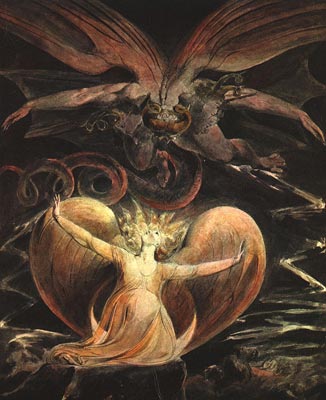 Blake was obsessed with the image of ‘the creator’, painting the image of God himself in his work called ‘Ancient of Days’. It shows the creation of the world.
 One piece of literature know throughout the world is Dante Alighieri’s ‘The Divine Comedy’. Blake was commissioned to create an ensemble of images to go along with the works. Blake never finished his works making them the last of his career.
‘Palmer was only nineteen and the experience was enormously important to him. ‘Do you work with fear and trembling?’ Blake asked him. When he died, 12 August 1827, Blake was working on a series of designs illustrating Dante.’ (2000; 55 Wu)
‘The Divine Comedy’ is seen as one of the greatest pieces of literature, so to be asked to illustrate the work must have been a grand occasion for Blake. It is sad indeed that he died, unable to complete his work.
 Whilst other artists in the Romantic age explored their own imagination, Blake explored that of others and his own beliefs. All fields that Blake applied himself to he excelled at but most always had a spiritual edge allowing us to see into William Blake’s life and not only see him as an artist or poet, but as a person.
Bibliography:
Why William Blake is the greatest artist Britain has ever produced, Jonathan Jones,
http://www.guardian.co.uk/culture/2005/apr/25/williamblake (Accessed on 25 April 2005)
Jessica Gunderson (2008) Romanticism: Movements in Art; Mankato; The Creative Company
Stuart Curran (1993) The Cambridge companion to British Romanticism; Cambridge; Cambridge University Press
Duncan Wu (2000) Romanticism: An anthology with CD ROM; Hoboken; Wiley-Blackwell
Robert F Cleckner/ Gerald E. Enscoe (1975) Romanticism: Points of View: Issue 40 of Wayne books; Michigan; Wayne State University Press
Michael O’Neill/ Mark Sandy (2006) Romanticism: Romanticism, belief, and philosophy: volume 4 of romanticism; Oxford; Taylor and Francis
Now I am going to go back to bed so I can try and get rid of this studid Head Cold by tommorow. Good Night
I would like to highlight that lecture 2 of the unit time machine is up and running, it is also good to know the podcast is also available, so for anybody who missed I advise to listen to it accompanied with the Powerpoint, because it will give you a little more of context of the Enlightenment Age.
It is under My course> Time Machine Unit> Content> Lecture 2 Podcast and Respective Powerpoint.
It is under My course> Time Machine Unit> Content> Lecture 2 Podcast and Respective Powerpoint.
Subscribe to:
Posts (Atom)